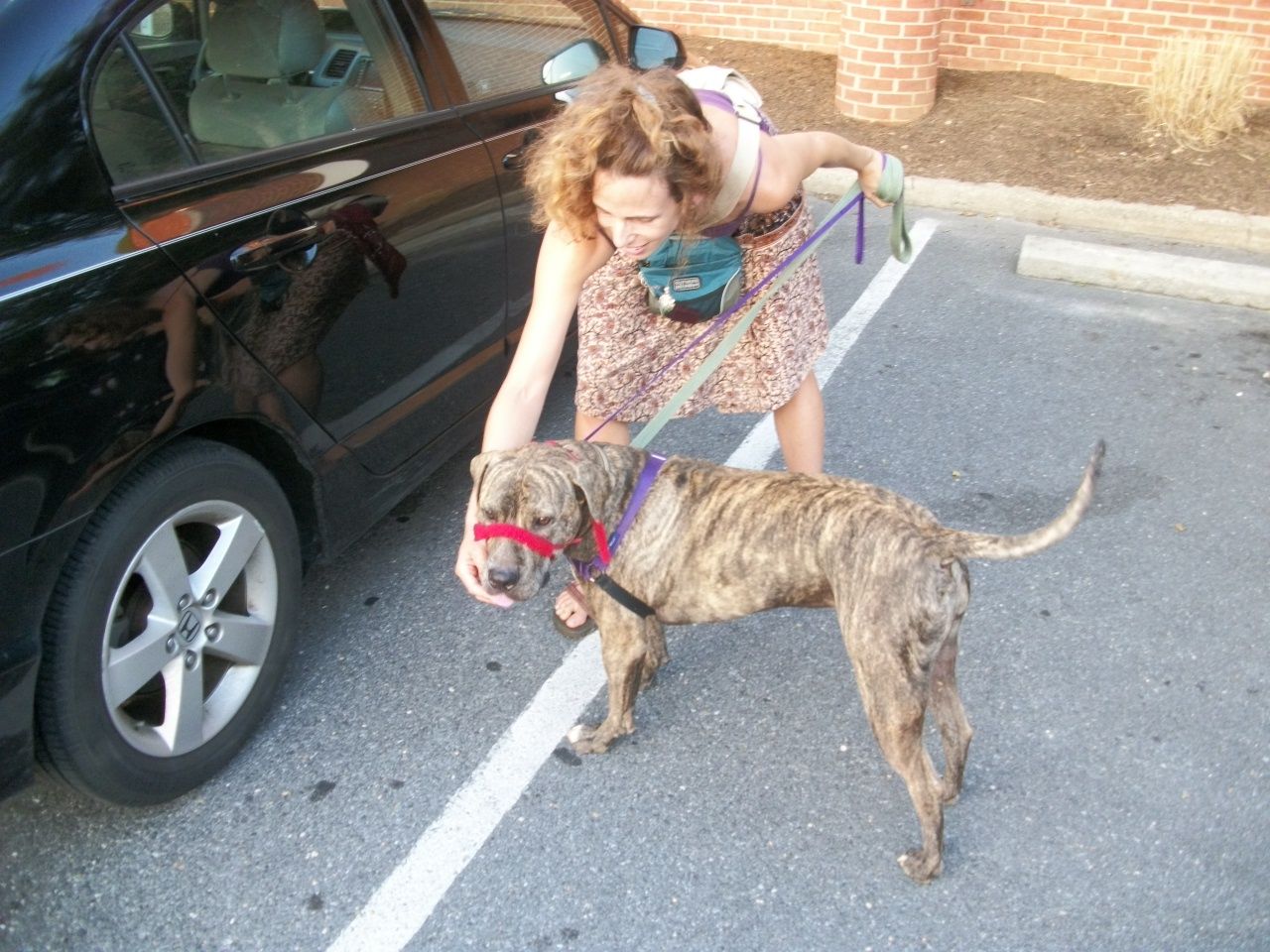
Showing posts with label impulse control. Show all posts

Friday, May 24, 2013

Tug of war for teaching impulse control and bite inhibition

Many of us, especially those who have worked with bully breeds, have heard the advice to never engage in tug of war with a dog, and if you do, never to let the dog win. Usually the argument is that the dog will learn that he's dominant to his people if he ever wins the object of the tug game, or at the very least that the game can get out of control easily and result in teeth making contact with human--something we certainly want to avoid. 


Recently I went to a free workshop with Your Dog's Friend, where I learned not only how to engage in tug of war safely, but also how to use it as a great training aid to exercise dogs, bond with them, and teach them to control their impulses. 


The basic outline is this:
  • Get your dog engaged in tugging with a sturdy toy
  • With the hand that's tugging with your dog, go limp. The hand remains on the toy but stops providing any resistance. With the other hand, reach out and hold your dog's collar.
  • With the hand and the toy limp, the dog will realize that the game is much less fun. Be patient and she will most likely drop the toy.
  • The second she does, say "Yes!" and take your hand off the collar, and start engaging in tug again. Encourage your dog and make it happy and fun. 
  • Repeat until you are both tired. When its time to stop for good, drop the toy, say All done!, and walk away.
This game is an example of the On-Off Switch game for impulse control. The idea is that many dogs can dial up to a frenzy in no time, but can't easily dial back down. If you can teach them to engage in intense play, then stop and relax, and get rewarded for relaxing by playing again, and so on, you will teach them a very valuable tool in getting along in a world where sustained dog intensity is generally frowned upon. 

You can find a very detailed, more complex outline of how to use tug of war as a training tool here. 

What's been YOUR experience with tug of war? Do your dogs like it, and can you get them to disengage when it's time to stop?

Tuesday, March 5, 2013

Another impulse control exercise: slow treats

We all know the dogs: generally on the exuberant side, but sweet-tempered and overall wonderful dogs, who nonetheless leave you counting your fingers when you give them a treat. 

Many of us have such a dog, who has readily learned all sorts of skills and tricks but has not quite learned that the reward for all those good behaviors will still be there even if they take it gently and slowly.

Star has a lot to learn in the Take Treats Gently department, and Lamar, probably due to his levels of anxiety, has a hard time remembering to take treats calmly and not as if his life depended on it. 


Fozzie, for some reason, has the most gentle, velvety soft mouth imaginable, and he has from Day One with us.


But certainly many of the dogs in shelters have this problem, and teaching them to take treats calmly can increase their prospects for adoption.

The APDT Chronicle of the Dog has been having a Train to Adopt series, and the article in the September/October 2012 issue provides a quick outline of how to train taking treats calmly. 


Shelter dogs are meeting all sorts of people, many of them nervous and not very dog-savvy. If the dog jumps up to snatch at a treat offered by a nervous hand, that hand will fly away--teaching the dog that he'd better move faster next time. 

For dogs who already know to sit automatically for treats, the process is really similar to how we train Leave It. When the dog sits, we offer him the treat. If he lunges, jumps up, snaps at our hand, or takes the treat less than gently, we withdraw the hand quickly. We keep pulling the hand away every time the dog jumps up or snaps at the hand. Only when the dog remains sitting calmly even as the hand is snatched away do we leave the hand in place and allow him to have the treat.

When I first read about it, the method of snatching the treat away at the last minute seems a little like teasing the dog. But I can see how getting a dog used to this, and showing the dog that a reward will come if only he can remain seated--especially in a shelter environment with lots of unpredictable interactions with new people--can help build a bombproof dog. 

I guess the problem addressed by this exercise--the dog who loses his "sit" when the treat goes away--is a little different from the problem of the dog who doesn't take treats gently. But I would be very interested in hearing your methods for teaching either life skill.

Tuesday, January 15, 2013

The "Nothing" exercise for impulse control training

My sister recently expressed an interest in adopting a second dog, and told me to keep my eye out, next time I was at the shelter, for a dog in the 4-5 year age range. I found not a one.

Take a tour of your local shelter and you are likely to find the same thing--an overabundance of dogs between 8 months and 2 years. Having fostered a handful of these dogs in the past year, I can see exactly why: they don't stop moving. Tiny puppies are perpetual motion, perpetual pestering, perpetual get-into-things machines but they are impossibly cute so it's easy to forgive them. 

Once they start looking like adult dogs, but still haven't slowed down, a lot of adopters just don't know what to do with them anymore and so they end up at the shelter, with all the other dogs their age. 

Of course any training is going to be helpful for these dogs; learning to sit, down, leave it and the rest gives constructive activities and options for their brains to engage in, instead of destroying things and pestering people nonstop. 

Pam Wanveer, when I was taking Sandy for her TTouch sessions, showed me how to just hold the dog's collar, and resist all the struggling, sniffing, and fussing around, until the dog is calm. 


The article by Sue Sternberg in the "Train to adopt" series in the September/ October issue of the APDT Chronicle of the Dog describes a similar exercise as the Nothing exercise. 

You can practice this in the shelter, in a quiet room where there are few other distractions--perhaps the room where visitors can meet dogs. 

Sit in a chair, put some bedding or a blanket at your feet, and hold the dog's leash with very little slack and most of the leash folded into your hand. Stare into space, sit straight up and ignore the dog. 

The dog will fuss around for a while--trying to chew your shoes, jump up on you, kiss your face, sniff around, etc. Ignore it all and hold the leash, holding it tighter if you need to limit some of the activity. 

Wait for the dog to lie down on the bedding. As soon as he does, look at him, stroke him calmly, and tell him how good he is. 

When he bounces back up again, immediately disengage and look away. As soon as he lies down, repeat with more attention.  

The time he can remain lying down will increase, and the times between will decrease, as soon as he realizes that calm behavior brings the reward. 

What a simple, wonderful way to help shelter dogs and foster dogs learn to be calmer, more controlled, and more appealing to adopters!

Friday, October 19, 2012

Impulse control for the fence barker

I recently went to a seminar sponsored by Your Dog's Friend on impulse control, which as you know is one of my favorite topics. I learned some useful tidbits!  

Like this: did you know that when a dog shakes himself off, it's one sign that he is shifting from hindbrain mode to forebrain mode--in other words, into a state where he can once again think and learn?

When I think of all the times when Fozzie reacts and barks and lunges at another dog when we see one on our leash walks, and then, when the dog is past, shakes out and then looks up at me, it makes perfect sense.

The other really useful thing was a little primer on what to do about the fence barker. 

The dog who, like Fozzie, goes absolutely nuts running along the fence line and yodeling up a storm when the poor mailman comes by, or when our friend with the huskies walks past. 

Why not try this:
  • Go outdoors with the dog on a leash. 
  • Do some structured attention work with the dog while no triggers are present.  At a time other than mailtime or husky walk time, call the dog's name and give a treat when he looks at you. Do the Watch Me game: Hold a treat out to your side, and wait til the dog looks away from the treat and into your eyes--then click and deliver the treat. Do some Sits, Waits, and Hand Targeting. 
  • Do this in your front yard, or wherever the dog does his fence barking, for a few minutes every day for a few days.
  • Then go out with dog on leash when you know there are going to be some triggers, like just before the mailman comes. Start getting some calm attention and eye contact with treats. 
  • Then its just like you would do with your reactive dog exercises during a leash walk. When the mailman comes, and your dog becomes aware of him--but is not yet flipping out and straining to get at him--say "Look at that!" then click and treat. 
  • Your dog may not be able to look at you at this level of excitement, but if he does, great. If not, stick the treat right in front of his mouth. Back up to just inside your doorway, or some other location farther away from the mailman. 
  • If your dog starts flipping out immediately when he sees the mailman, just say "whoops!" and bring your dog back inside.
  • As you practice presenting treats when the mailman comes each day--ideally, at a point when your dog notices the mailman, but before he is freaking out about him--then he will become calmer and more able to process information over time. 
The process is really just like reactive dog training--working sub-threshold, doing open bar/closed bar desensitization and counterconditioning with the dog's triggers.  I just never thought of putting together a structured protocol in this way. Brilliant!


Do YOU have a fence barker, and a good way you've found to work with those less-than-desirable behaviors?

Thursday, October 4, 2012

Loose leash walking

Though I've taught it in lots of classes, I never have felt really confident about training Loose Leash Walking--especially to dogs who really need it. 

I'm sure there are plenty of dogs out there who will respond quickly to the "be a tree" method--when the dog pulls, stand still until she looks at you and gives you some slack, then go forward again until the dog learns that she can only go forward when she gives you a slack leash. 

But a dog like Fozzie needs something more intensive. So I was glad to see that the APDT has a free webinar on Loose Leash Walking--which I believe is available to everyone here, even if you don't have an APDT membership. This webinar is offered by Gail Fisher, and goes through the steps of a nice, relationship-centered way to help a dog learn to walk calmly on the leash.
Lamar, always concerned with keeping his flock together, walks on a nice loose leash and checks in frequently
I always find that writing things down helps me learn them, so I've summarized the steps below. I hope this is useful to you too.
  • Choose an alert sound like This way! or a smoochy noise. Use this sound to let your dog know you're going to start working.
  • Make your alert sound, and when your dog looks at you, mark (click or say "yes!") and toss a treat on the floor. When dog looks up at you, click and toss again. Repeat 5-6 times in place.
  • Then walk backward, continuing to mark and reward for the dog looking at you.
  • Once dog is walking along with you and getting into this game, pivot, turning away from your dog, so you're facing in the same direction.
  • After you turn, mark & reward first step going in same direction. Walk with your dog a few steps, marking and rewarding for each step she stays in loose leash position. 
  • To turn, make smoochy noise to signal first then turn. Say Lets go to let dog know you're going.
I like this protocol because you are working towards loose leash walking through establishing a relationship with your dog, and being clear about what you want.  

Important points: you're not luring the dog into position, and you're not rewarding just for attention. You are marking and rewarding moments where the leash is loose, even if the dog is not looking at you.   
Florian always gets Loose Leash Lamar, while I get pulled along by Fiendish Fozzie
What about when your dog gets out of loose leash position? The usual instinct is to yank back, but here's something to try that's a lot gentler and more fun:
  • As your dog starts to pull, but before he gets to the end of the leash, make your alert sound (smoochy noise)  
  • Walk backward to reconnect, as at the beginning
  • Mark, then reward only with verbal praise--no treats. Treats are only for forward walking
  • Turn and walk forward, then click & treat for a loose leash!
This seems like a great protocol for dogs who are over-eager on the leash, but still interested in treats when out on a walk. 

But what about for dogs who, like Fozzie, are so stressed out, anxious, or excited on walks that they lose interest in treats?

This is why I found the end of the video, which talks about the Lost Opportunity marker, so interesting. The steps outlined are exactly the method I discovered and outlined here as the only thing that really works for Fozzie, once he gets a bit excited: Using a No Reward Marker like "whoops!" when he pulls out ahead toward a trigger, then immediately turning and walking in the other direction until he gets more calm. Turning back toward trigger if he can handle it, but turning away while saying "whoops!" if the leash goes tight again. When he can handle it, allowing him to approach all the way to the thing he wants.

This method is putting the Premack Principle to work for you: giving the dog something he wants (to approach the object of his fascination, whether another dog or a good-smelling bush) in exchange for giving you something you want (calm behavior and a loose leash). Whoever Premack is, he is a godsend to those of us with dogs who--for whatever reason--are not food-motivated.

The rest of the video tells you how to build the behavior by gradually increasing the time between rewards, introducing turns, training in new locations, and adding distractions. It also includes the good advice that if you don't have time to train on a walk, use equipment, like a head collar or no-pull harness, that will keep your dog from pulling and practicing the behavior. 

Check out the video for a really thorough explanation of these great methods. I'd love to know what works for you.

    Friday, May 4, 2012

    Enforcing boundaries is not being a meano (or so they say)

    While I've seen some students of mine struggle with the idea that new behaviors can be taught more quickly and efficiently with positive reinforcement than with leash tugs and alpha rolls, my own struggle is with being a bit "tough" when it's called for. 

    Occasionally, everyone is able to just Chill Out together on the bed
    In my ongoing struggle with Fozzie and Lamar's nighttime turf battles, it's been hard for me to just lay down some rules about where everyone should sleep. Fozzie craves physical contact so much, and looks so sweet and innocent as he approaches the bed, I couldn't bear to just tell him to stay in the living room and sleep on the couch--even though I know he's quite happy there. I thought that by just giving everyone treats, I could stay on the right side of positive and make everyone happy.


    In our TTouch session with Lamar, one of the things Pam really emphasized was that the easiest solution to our nighttime grumpiness dilemma is just better management. 


    It won't kill Fozzie to stay in the other room, at least until Lamar is asleep. In fact, it may make him feel safe and content to have his human tell him exactly where he needs to go. 

    When I've actually done it, he goes right out to sleep on the couch and doesn't come back. Sometimes since we started doing this, he's just chosen to go out to the couch on his own, seemingly relieved to escape poor Lamar's drama. 


    Sometimes, I just tell Fozzie to stay on his bed, where he can look at us but not be in Lamar's space. He's able to do it! 

    What self control to be able to look at us and resist being close to us, to feel the tension of Lamar looking at him too but feel secure enough in himself that he didn't need to anxiously seek out human contact. 


    A good exercise indeed for dogs to learn valuable life skills of impulse control...while this human learns to control my own impulse to cuddle Fozzie every minute I possibly can. 

    Do I get some yummy vegan human treats if I get better at it?

    Monday, March 12, 2012

    More canine cultural enhancement

    This past weekend Florian performed his thesis concert, the culmination of more than a year of incredibly intense work. The piece, Profondeur Inconnue, was his first major choreography, and after a year of hearing Oh, Zuzi, I am not a choreographer, I was so impressed. 

    Florian wanted to create a piece with an underwater theme, and together we came up with the idea of exploring survival underwater following catastrophic sea level rise as a result of global warming. 


    The result was spooky, and positively moving. 


    And the best part was that we got to have a party this weekend with these lovely people who have put up with Florian this past year.

    It's rare that I encounter a roomful of people who understand me so well. 

    The icing on the cake? They love dogs. 

    I think Fozzie is getting accustomed enough to gatherings at my house that he is finally able to settle down while the guests are still here. I love that I don't always have to have him on the leash, but can, with a handful of treats and a few minutes of attention, sometimes get him calm enough that he can contain himself fairly quickly. 

    After some initial launching every time a new person came in, he found a comfy place on the couch, plotzed out, and just soaked up the lovin'. 


    Of course he adored it when everyone gathered around to watch Florian's first major project at the university, a video project featuring some intimate moments between him and Fozzie. 


    So great that my dogs are getting to soak up all this culture. Hanging out with all these musicians and dancers can't help but have a positive effect on these canine youth, don't you think?


    Tuesday, January 31, 2012

    More T-Touch and Impulse Control

    With our newfound commitment to an ambitious self-improvement program, Fozzie and I were ready for our second T-Touch session last week. 


    We went into Pam's bathroom to start out with, so she could work with Fozzie in a small space where there was not too much for him to sniff, explore, and distract himself with. 


    As before, he spent the first 10 minutes or so doing everything he could to keep busy and avoid just "Being Here Now," as us hippies would say. Sniffing the toilet, the floor, the picture frame, the window, the door, the towel rack for God's sake, then whining, pacing, circling, wagging, and looking at us entreatingly. 


    After a while, he finally just lay down. Pam then started narrating all the little releases she saw. Stomach gurgle-yay! Release! Burp--Yay! Sigh, yawn, lip lick, blink, flatulence--yay!


    She began doing some cranio-sacral work on him, just holding the bones of his cranium as they shifted around slightly. His lips and nose began to twitch, and Pam told me when she felt his C2 vertebra release. 


    And I thought, here's a dog who was hours away from being thrown away like so much trash, and now he has a T-Touch practitioner tuning in to his C2 vertebra and helping it release. Pretty cool. I wish every impulsive shelter dog awaiting rescue could get that kind of attention.  

    Pam taught me a simple impulse control exercise. Sit in a chair with the dog sitting between your legs, facing away. Hold the dog's collar and just wait. 

    The dog, depending on his impulsivity, will whine, struggle, paw, chew on your hands. Ignore it. Avoid eye contact and just take away any of your body parts that is being chewed upon. Eventually, the dog will lie down. Great. Keep holding the dog until he really relaxes, so when you let go he doesn't just bounce up. When you do let go, just calmly flow into getting up and doing whatever you were doing, without making a big fuss. It works like absolute magic and is a dream for any dog that is all over the place with energy and doesn't know what to do with him or herself. I tried it on Sandy the other night when she was bouncing around like a maniac, and she fell asleep, and then stayed asleep. 


    After Fozzie spent some time getting in touch with himself in the bathroom, we went outside to do some groundwork. Groundwork is as integral to TTouch as is the bodywork component; it's the part where the dog gets to practice walking through obstacles, over novel surfaces, etc. so that he learns to pay attention to his body even when in stimulating outdoor environments. 


    I'd brought Fozzie with his head halter and a body harness. Pam walked Fozzie through a PVC labyrinth and over some obstacles she created with boards, and showed me how to gently lead his head with me when he stares at a squirrel, tenses at a dog he sees in the distance, or otherwise starts to react. The main force of my pull is on his body harness; there is a gentle tug, but not a yank, on the head halter to make sure we don't injure that burly-looking-but-still-vulnerable neck.


    She lifted his paws and rotated his legs as he stood on the board, to get him to loosen up those tense things as he inclined toward a squirrel.


    I was glad that Pam got to see how impossible it is to get his attention back once he fixates on something. She was confident, though, that with regular practice of impulse control, TTouch to get him more grounded, and gentle work with the head halter, we will be able to get his attention at some point down the line.


    Fozzie loves all the sweet attention he gets with Pam and I love learning so much about progressive, even revolutionary ways to interact with my powerful, distracted, sensitive, misunderstood friend.

    Thursday, January 19, 2012

    Wintry Wanderings

    The extra day off this week gave us the opportunity to explore the Patapsco Valley State Park, a vast land of many trails surrounding the Patapsco River near Ellicot City in Maryland. 

    I love these hilly forest hikes in the winter, where you can see for miles around through the leafless tree branches. 


    On a bracingly cold holiday Monday, there was barely anyone to worry about as all three dogs rans around like maniacs. 

    Fozzie did take off after something at one point, and the others followed him over a hill. They came right back, though, and even the wild impulsive man was back soon enough.  


    Maybe they--especially Sandy--don't want to miss an opportunity to play those wacky stick games. 
    Dogs are so amazing--give them miles of wilderness to roam around in and they still seek our companionship. 


    And I think there's even a good lesson here for those of us still working on teaching our friends better impulse control. It goes back to what I learned in the Control & Focus class I assisted in, which was based on Leslie McDevitt's Control Unleashed.  


    If we make it rewarding enough for our dogs to be close to us, then the moment when we release them to wander is almost a let-down. They choose to be with us even when they have the opportunity to do otherwise. 


    Easier said than done with some dogs--like Fozzie, who channels his inner Plott Hound and forgets he's supposed to be a biddable breed when presented with temptations like open space and the possibility of prey species. But its a good principle, and even with Fozzie I think there's hope!

    Friday, November 18, 2011

    Tennis Court Impulse Control

    You have probably gathered that Fozzie's greatest remaining training challenge is his overexcitement on leash when he is exposed to things in the outside world, coupled with his frustration at being restrained from meeting those things. What usually results is a spirited game of leash tug of war to which his foster mom is not a willing party, and which only ends when I grab him by the harness and give him a brimstone-laced Sit!

    Lately I've been making a concerted effort to work on this by taking him to environments that are likely to be stimulating and allowing him to practice being calm. The other night, I took all 3 dogs for a walk together along a trail near us. Not the most brilliant way to practice being calm, though I must say that even then, as long as I had my cheesy snacks, I was getting nice sits out of Sandy whenever I asked for them, and even Fozzie would tune in as long as there was nothing tooo exciting going on.

    After our walk, I wanted to take Fozzie alone a bit so we could work on just calmly observing the environment and refraining from acting out. The perfect opportunity presented itself when I realized we were parked right next to a tennis court. 

    There were a bunch of men on the courts running around, jumping, grunting, hitting balls, and talking loudly. There were a few guys lounging on the benches outside, talking loudly to friends as they showed up. Watching all that, who wouldn't get excited?


    So we put the other dogs in the van, and Fozzie and I just watched. He did perfect Sits and Watch Mes in exchange for cheesy snacks as the guys ran, grunted, and talked loudly. I explained to one of the guys outside the courts what we were doing, and when we got closer to him, Fozzie gave his leash that Look like he wanted to grab it so bad, but I was present enough to issue a quick Sit! and an equally quick cheesy snack when he did.

    An aside: the man was intrigued when I brought out the clicker, and started talking about that show on Animal Planet! He said how incredible it was what the lady was able to do with a clicker and all sorts of dogs. For all the times I've heard people talk about that OTHER TV dog trainer in passing, this was the first to mention Victoria Stillwell. Yay!


    In any case, I was so proud to be with my big bully man and to have him sitting so nicely in a challenging environment for him. Way more proud than the time recently I was walking all 3 dogs and a passerby said something to me, and Fozzie AND Sandy both started furiously tugging on their leashes, and there I was on a busy street grabbing at their collars and yanking them away from each other and cursing a mile a minute. I know, brilliant. Roll up that newspaper and gimme a good smash.

    It's really not rocket science. Its a matter of getting out and practicing frequently, with just Fozzie. Maybe he really would make progress if I could just do this consistently.

    Monday, October 10, 2011

    Time-outs

    Jen at the Inu-Baka blog had a great post the other day about time-outs.

    It may be tempting to think of a time-out as a punishment, but I think of them more as training tools.

    For many dogs rescued from shelters, impulse control is a key life skill and one that will serve them well with prospective adopters. A lack of impulse control may well be what landed them in the shelter in the first place. For many breeds, including the pit bulls that comprise the bulk of the shelter dogs in my area and that happen to be my two current foster dogs, a tendency toward impulsiveness is what often gets labeled "aggression" and is used to justify their "unadoptability' and death sentence.

    Helping these dogs learn to dial it down, to take a break when things get intense, to have an off-switch that is as well-developed as their on-switch, can be a lifesaver for them as well as a huge help to us, their caretakers.


    Some degree of wild play is appropriate and healthy, especially for some breeds. I'll let my pitties get pretty loud and vocal, and I'll allow them to chew on each other and slam each other and even climb on top of each other as long as I see that both are enjoying it and neither is trying to get away from the other.


    But when the vocalizations start to get a quality of desperation to them, when Fozzie looks like he's needing a break from that little perpetual motion machine, or when us humans just need a few moments of blessed silence, its nice to have a crate to put our little piglet in for a while.

    Always with a delicious chew so it doesn't feel like punishment.


    These time-outs are not only essential for everyone else's sanity, but I believe  important as well for Sandy herself to learn to rein in her energy after bursts of wildness. So that in addition to her cuteness and sweet-temper, she can learn the self-control that will make her an even better ambassador for her breed. 

    Thursday, November 11, 2010

    more exercises for impulse control

    I was assisting at Al Winder's Control and Focus class with Your Dog's Friend this past weekend, and was reminded of how great some of Leslie McDevitt's exercises are for calming impulsive dogs and helping distracted dogs focus on their people. In Control Unleashed, McDevitt describes a few ways to help distracted dogs that use completely positive methods. Here is one of them:

    Gimme a Break
    This exercise is great for the dog who is way too  interested in squirrels to focus on you when you're on a walk, or way too distracted by the other dogs to concentrate on the exercises when you're in your agility class. The exercise helps the dog reorient to you by showing him that focusing on you is what's really rewarding...not by punishing those times when he is distracted.
    1. Choose a behavior to work on, and an enclosed, low-distraction area like a fenced yard or large basement to work in. Behaviors you might work on include Go to place,  walking in heel, or even playing tug of war. Have a chair for you to sit in.
    2. Start working on your behavior, rewarding your dog frequently. If you're doing Go to Place, reward your dog frequently as long as he's on the mat. For Heel, walk in a circle and reward as you walk and your dog stays close by you and gives you his attention. 
    3. After a minute or so of working, say your release word like "All Done" or "Break" and turn away from him and go sit in your chair. If your dog disengages first by looking away or going away from you to sniff, immediately go sit in your chair.
    4. For up to a minute, allow your dog to sniff around and do his thing while you stay in your chair. Do not talk to him during this time; remain unengaged. 
    5. The second your dog reorients to you--glances your way, turns an ear towards you, or comes up to you in your chair, you want to reengage him in your rewarding exercise. Resume walking, going to mat, or doing whatever you were doing, with a high rate of reward.  If he does not reorient to you, reengage him and resume the work you were doing .
    6. Very gradually extend the time of your training sessions, but keep them short enough that your dog does not choose to disengage before you say your release word.
    Lamar taking a big break!
    The goal of this exercise is that your dog becomes less interested in distracted sniffing around, because focusing on you is so rewarding. As dogs practice, they quickly get to a point where they don't even want to take a break--instead, they remain focused on us when we give the release cue and ask us to keep working.

    If you work on it in low-distraction environments until your dog is reliably reorienting to you after you release him, you will gradually be able to count on his attention even in very distracting environments--like in the backyard with all those squirrels!

    Monday, April 19, 2010

    Adventures in Leave it + watch Me

    I realized this is the perfect game for Fozzie. Tonight, we worked on it in the back yard with his second favorite thing, a stick. He has already learned that he needs to sit before I do anything he enjoys, so he sat as I lifted a stick above his head, said Leave It, then seductively, slowly, waved it in front of his face. He stared at the stick, then the eyes flicked toward mine and I said Yes! and immediately threw the stick. He got it, came right back and we played again, and this time his eyes went toward mine almost immediately.


    I am amazed at how quickly he learned that the eye flick was what I was rewarding! I have always had difficulty with Watch Me, but I was practicing with Lamar--a far less biddable dog, and one who has fear of trying things to boot.


    On our walk this evening, Fozzie demonstrated that he'll need more work before he'll listen to Leave It when he's doing his first favorite thing--playing leash tug of war when he gets stimulated. There was no Leaving It once he got into that leash tug, while we were on a busier street and I was stopping to talk to everyone who admired him and asked about adopting him. After those episodes though, we did get to a quiet street where he started to go for his leash, then responded to Leave It! Victory!

    Thursday, April 15, 2010

    Premack


    I am really getting an appreciation for the subtleties of dog training. After reading Control Unleashed (Leslie McDevitt's absolute gem of a training book) and in class with Michelle Mange, my brilliant mentor with Right Start Maryland and Your Dog's Friend, I realized that to get Fozzie to mellow out, I need to give him a reward that's worth more to him than just these cheesy bits! What's the most rewarding thing to him? Going wild! So what should be his reward for not going wild? Legalized going wild!


    There is a great handout on impulse control at Dogscouts.org, so I won't belabor it here; the basic idea is that for dogs who really want to play, they get to play only after they relax and take a break. So with Fozzie, throw a ball, do some push ups, pet him like crazy, rile him up a bit (I'm not doing tug of war with him because it's too stimulating; tug of war would be a good choice for dogs who enjoy it but don't get too into it), then disengage. Look away, take the ball away, stop playing until Fozzie sits and looks at me calmly. May take a while, but ignore him til it happens. Then--start again! Go wild, take a break, go wild, take a break. The Premack Principle--using something pup really wants to do as a reward for doing something he's less psyched to do.


    Necessity breeds creativity, and Fozzie is the best teacher ever.